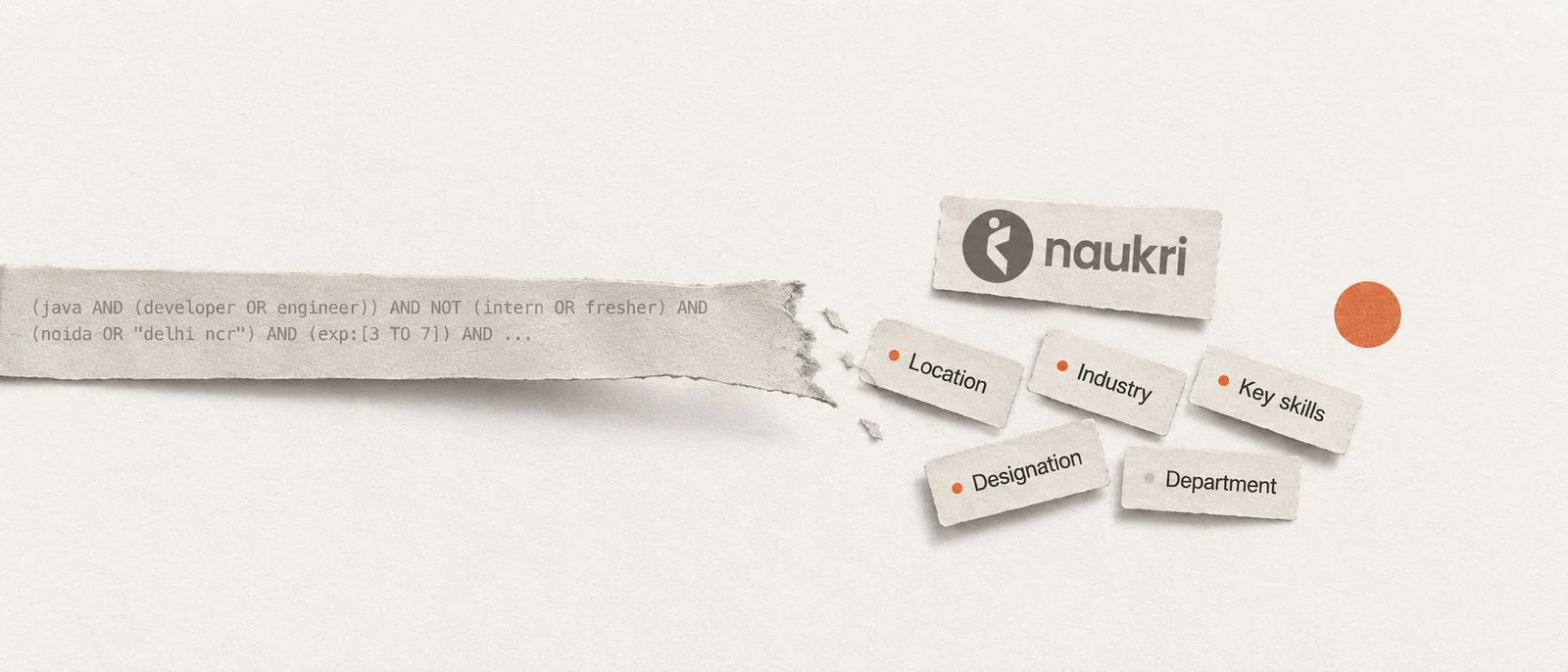

Enterprise sourcing was built for recruiters. Most small businesses don't have one.
Resdex is the resume database behind Naukri, built for professional recruiters. Resdex Lite is the same database made usable by a small business. Search it with five plain questions, buy a small pack online, and start calling candidates the same day, with no sales call and no training. I led the design from the first field visit to final acceptance, without disturbing the enterprise business it grew out of.
02 /What you'll see here
The work is real. The artifacts stay with Naukri.
Everything below is real: the field visits, the decisions, the fences. The artifacts themselves, the research files, the dashboards, the internal screens, belong to Naukri and to the people who shared their data with the platform, so they stay there. Where a picture helps, I have recreated the idea instead of exposing the asset. In a room together, I am happy to go a level deeper on any of it.
03 /The problem
For a small business, hiring is not a job. It is an interruption.
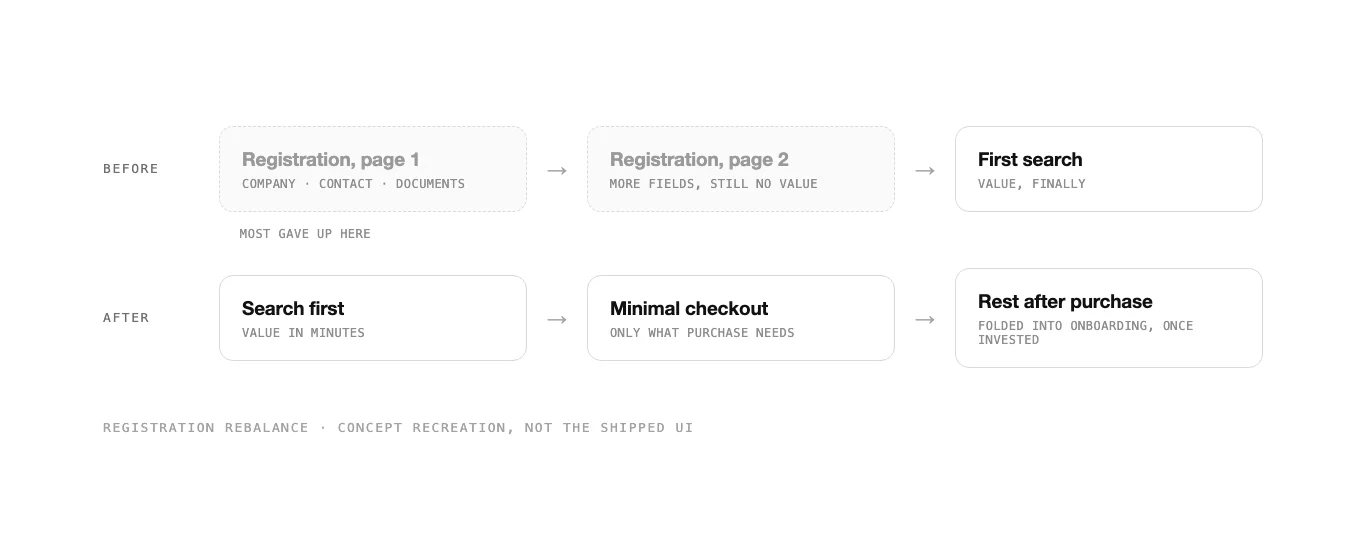
Resdex assumes a recruiter at a desk: search strings, saved queries, a setup that rewards someone whose whole day is sourcing. A small business does not have that person. The owner or the office manager hires when a resignation forces them to, on a phone, between a supplier call and a delivery. Our own instrumentation showed exactly where that person gave up: heavy, multi-page data collection before any value appeared.
Enterprise Resdex, on Naukri ↗And Naukri had a strategic reason to care. Most of India's businesses are small, and most sit outside the big metro cities, beyond where an enterprise sales team can profitably call on them one by one. Reaching them needed a product that sells itself and serves itself. Resdex Lite was that bet, and design was how the intent became something a person could actually use.
So the brief was never to simplify Resdex. Simplifying an expert tool insults the expert and still loses the novice.
04 /Out of the building
We went to the market. Literally.
We did not wander into the field. The company had already mapped which kinds of small businesses were worth serving first, and the research followed that map. I structured it with a core product manager and a design researcher, and went myself: physical business clusters, contextual conversations inside working offices, and strict screening so we were learning from actual small-business operators, not convenient stand-ins. On top of that, we sat with fifteen-plus paying customers of the existing platform and documented their workarounds, their script sheets, and the exact points where the interface fought them.
Three kinds of people kept showing up. A consultancy reposting the same role every Monday because fresh applications dry up. An office manager running hiring from a spreadsheet, next to payroll and appraisals. And a consultant paying for database access and counting every closure against what it cost.
“Instead of showing the number of CVs, show the number of quality CVs.”
The interviews kept returning to the same shape. For these operators, hiring is one continuous workflow, understand the need, search, filter, contact, track, reuse, and everywhere a tool broke that chain, a workaround appeared: a spreadsheet of resume links, a WhatsApp thread, the same role posted again on Monday. “Right now I’m doing it all manually. It’s hard to keep track of these people,” one HR generalist told us. The product did not just have to make search easier. It had to serve the workflow around it.
Complexity is a churn trigger, not a learning curve.
An enterprise recruiter invests hours in a tool they use all day. A shop owner gives you minutes. If the first useful result does not arrive inside those minutes, they do not struggle on. They leave.
Silence reads as broken.
The interfaces gave no feel for the living marketplace: is this candidate active, is anyone nearby available, is anything happening at all. And every dead end taxed the little trust there was. “When we call, someone else picks up, or the call does not connect,” one consultant said. An expert knows the machine is working. A novice assumes it is not.
05 /The strategy
Prove it in two cities before betting the brand.
Small business is not one market. A consultancy, a factory and a five-person office hire differently, and what works in one city can miss in the next. So with the field evidence in hand, I worked with marketing on a launch built to minimise risk rather than maximise noise: start in two cities where a mistake stays small, watch who searches, who buys and who comes back, keep the rules that repeated, then grow from there. A national brand and a national database are not things you experiment on casually.
06 /The decisions
The intimidating part was never the database. It was the doorway.
We replaced operators and search strings with five plain questions any owner can answer: where, which industry, which skills, what designation, which department. Start typing and the tool suggests the rest. The enterprise power stayed underneath. The person no longer has to speak its language to use it.
Ask for the data when the person is invested, not before.
The legacy purchase path pushed an unverified visitor through two dense pages of data collection before anything useful happened. We tore that down and rebalanced it: the minimum before purchase, the rest folded into onboarding after it, when the questions feel reasonable. And the ask to buy appears only when the person has just seen candidates worth paying for, mid search or near renewal, and nowhere else.
Open the long tail without cutting into the core.
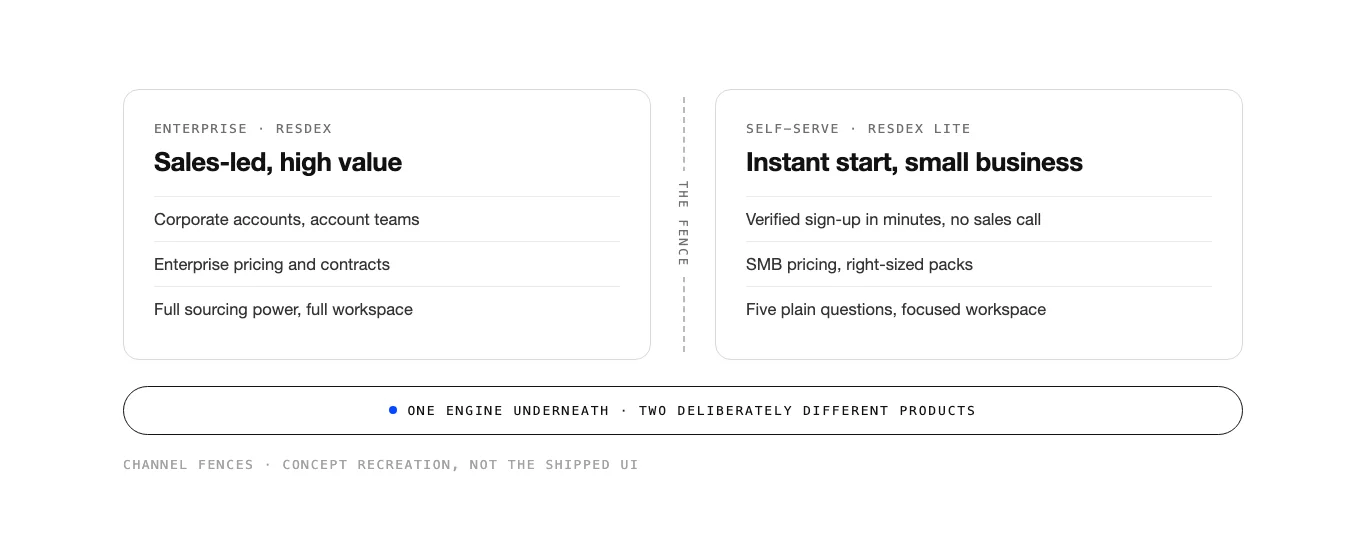
The riskiest failure mode was internal: a self-serve product cannibalising the enterprise sales channel it grew out of. So the boundaries were designed rather than hoped for, a pricing structure and experience limits that kept high-value corporate accounts and self-serve operators in visibly different products. In practice: a large agency with an account manager lands in enterprise Resdex and its contracts. A five-person firm lands in Lite, with packs sized for a small business, not a negotiation. Each gets a product shaped for them, and neither undercuts the other.
We caught the mismatch before the user did.
In technical reviews, the design team noticed the same search returning different result counts in Lite than in the main database. I took it to the data science team, and we made the interface reconcile the two before ever showing a number, because the count beside a search is exactly where trust is won or lost.
Company verification happens at sign-up, checked in real time by an external verification service instead of a manual review queue, so a legitimate business starts in minutes.
Personal details stay masked by default and first contact happens over virtual calling, so early conversations stay safe and on the platform.
07 /How it was delivered
Design ran inside the squads, not ahead of them.
I embedded senior designers into the delivery squads with explicit ownership: the core product flow, the mobile checkout, the marketing surfaces. Walkthroughs and acceptance testing happened continuously rather than as a gate at the end, and the working rhythm ran alongside the product owners, engineering leads and data science partners, not upstream of them.
The final acceptance review with senior leadership cleared the product. The engineering release came after my time, so what Naukri sells today is the team's story to tell.
08 /What carries forward
The craft was mostly invisible. That was the point.
The right five questions, a form split in two, a fence nobody notices: none of it photographs well, and all of it is the job. What I carry forward is that a large organisation took a brand-new product for a brand-new customer from first field visit to final acceptance, because design was in the room the whole way. That is what design leadership buys a business. Not prettier screens. Fewer wrong turns.
Role and credit: design led by me as VP of Design at Naukri, with senior designers embedded in the delivery squads, a core product manager, a design researcher, and partners across product, engineering, data science and marketing.
Ask AI about this case Live
Answers come from what this case actually says. Pick a lens, ask as many as you like.
Summarize this case
1. Resdex is Naukri's enterprise resume database, built for professional recruiters. Resdex Lite repackaged that engine for small businesses, where the owner hires between two other jobs.
2. As VP of Design I led it from the field research (market visits, deep interviews with 15+ paying customers we ran together) through a two-city launch strategy to a release-ready product, with pricing and experience fences that kept the enterprise channel protected.
3. My designers ran embedded in the delivery squads, and the design cleared final acceptance close to the initial plan. The engineering release came after my time; what changed between that review and today's product stays with Naukri.
4. The internal numbers, research files and screens stay with the company; the case shares the reasoning, with recreated visuals.